Picture the moment: a customer walks up to your counter, turns their phone around, and shows you a repair "diagnosis" they got from ChatGPT on the drive over. They've got a part number, a probable cause, and — often — an opinion about your estimate before you've said a word.
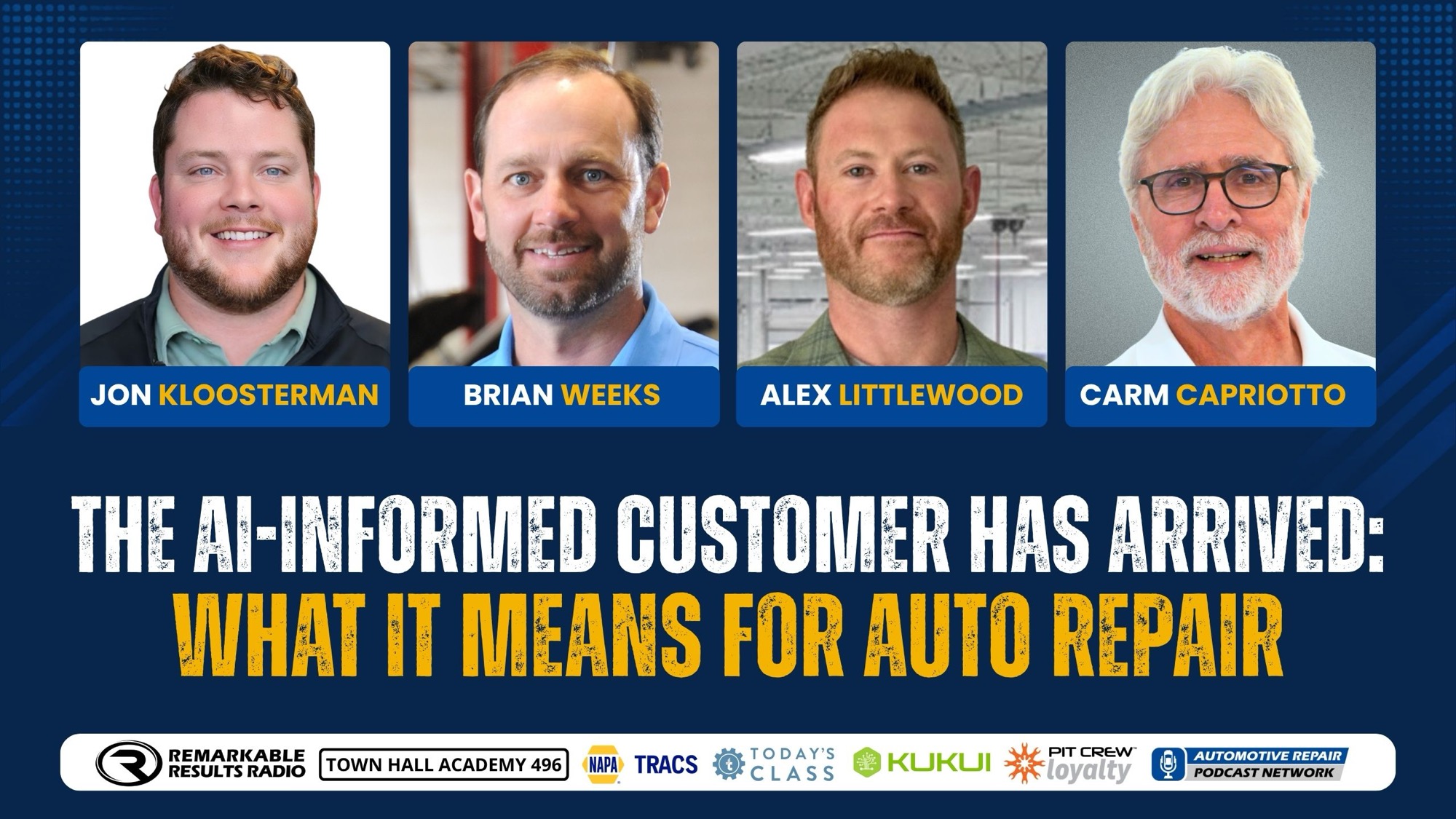
That moment isn't coming. It's already here. And it was the whole subject of a recent Town Hall Academy panel on Remarkable Results Radio, where host Carm Capriotto sat down with two shop operators and ONRAMP to work through a simple question: when the customer is AI-informed, what actually changes for the shop — and what doesn't?
Key takeaways
- The AI-informed customer is now the default, not the outlier. Assume the person in front of you has already searched.
- A confident wrong answer is still a wrong answer. AI makes customers feel more certain — that's an opening to lead with real diagnostics, not a fight to pick.
- Automate the admin, not the relationship. The wins are in paperwork, lookups, and documentation — the trust stays human.
- The "human premium" goes up, not down. As generic AI content floods everything, a real expert who explains the why gets more valuable.
- Efficiency shows up in the bay and at the advisor's desk — faster answers, cleaner documentation, less time lost to screens.
- Adoption is a people problem before it's a tech problem. Bring the team along or the tools sit unused.
The AI-informed customer is already at your counter
The panel's starting point was blunt: this isn't a trend to prepare for, it's the current baseline. Customers research symptoms, price parts, and form a theory before they ever call. That's not disrespect — it's the same instinct that sends people to WebMD before the doctor. The shops that treat it as a hostile act lose; the shops that treat it as a warm lead who's already engaged win.
Meeting the ChatGPT diagnosis without the ego
When a customer's AI theory is wrong — and it often is, because a language model can't hear the misfire or read the freeze-frame data — the temptation is to correct them. The better move the panel kept circling back to: don't win the argument, run the diagnosis. "Great — let's verify that" beats "that's not how it works" every time. You end up in the same place, but one path builds trust and the other burns it.
"AI is going to create new friction at the service counter — but it's going to create just as much opportunity. The potential productivity upside for shops is enormous, and that's exactly what we built ONRAMP to help with, so shops can focus more effort on the human connection."
— Alex Littlewood, Founder, ONRAMP
Automate the admin, not the relationship
A recurring theme: point AI at the work customers never see and never valued — the lookups, the warranty write-ups, the repeated data entry, the 4:45 PM documentation crunch. Automating that frees your best people to do the thing AI can't: look a customer in the eye and explain what's actually wrong with their car. The mistake is aiming automation at the relationship instead of the paperwork.
The human premium goes up, not down
Here's the counterintuitive part. As AI makes generic information infinitely available and free, the scarce thing becomes trusted human judgment. A technician who can say "I've seen this exact failure on this exact engine, here's what it really is" is more valuable in an AI world, not less. The shops that lean into expertise — and make it visible — are the ones that stay premium.
Where the efficiency actually shows up
For technicians, it's keeping hands on the car instead of walking to a terminal to dig through a legacy database. For advisors, it's having the right answer and clean documentation ready without the scramble. None of that replaces the person — it removes the friction around them. That's the practical, unglamorous version of "AI in the shop," and it's where the real ROI lives.
Bringing your team along
The last thread was adoption. New tools don't fail because they're bad — they fail because nobody changed how the day actually runs. The operators who've done this well framed it as a people problem: show one tech one win, let it spread, and resist rolling out ten things at once.
Why we built ONRAMP for exactly this
The through-line of the whole conversation is the one we started ONRAMP on: AI is most powerful when it makes expert humans faster, not when it tries to replace them. Voice-first answers in the bay, documentation that writes itself, admin that disappears into the background — so your people spend their time where the trust and the margin actually are.
See how ONRAMP works → — or book a walkthrough →.
Featured on
The AI-Informed Customer Has Arrived: What It Means For Auto Repair — THA 496, a Town Hall Academy panel on Remarkable Results Radio, hosted by Carm Capriotto, with Jon Kloosterman (WestSide Service), Brian Weeks (ATC Auto Center), and ONRAMP founder Alex Littlewood.


